Case study
Claims assessment
Southern Cross Health Society.

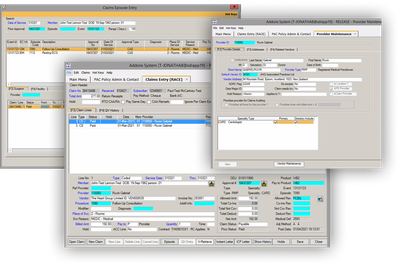
Every health claim Southern Cross pays passes through one internal platform. Assessors, underwriters, quality specialists and team leads all work in it, across more than 300 screens.
The software was reaching end of life. That was the reason for the rebuild, and nobody using it had asked. New starters took six to eight weeks to become proficient. Everyone else had years of workarounds.
The ask was narrow. Rebuild the thing assessment happens in, without redesigning how claims get assessed and without making anyone's day worse.
Getting design into the programme
The team was already writing user stories when I joined. A BA owned requirements. There was no designer and no design process.
The first module was underwriting. A small user group, low volume, low impact. The business picked it as a low-risk place to start, which made it a good place to establish design too.
The textbook answer is a discovery phase, a research plan, and design sign-off before development starts. Asking for that would have made me the person who arrived and slowed the work down. Accepting the shape as I found it would have left me drawing screens against decisions someone else had already made.
I did neither.
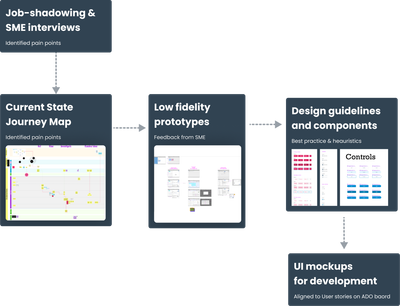
Week one, observe. Week two, job-shadow underwriters and build a journey map, validated with SMEs. Week three, low-fidelity prototypes in front of SMEs, with BAs as note-takers. Week four, a style guide, before the front-end team went too far to change. Week five onward, delivering features with the developers.
No step required permission. Each was small enough to absorb and useful enough to be wanted again.
By the end of the underwriter phase there was a way of working to carry into the assessor work. Claims assessors were the largest group on the platform and its heaviest daily users.
Comparison, not sequence
Ten interviews with claims assessors, quality specialists and team leads, run remotely under COVID restrictions. Then two rounds of prototype testing, the first taking the simplest journey through a claim to check the model held.
Remote sessions hide how people physically work. We asked participants to share their screens and complete real tasks rather than describe them.
I suggested the Product Owner, the BA and some of the developers sit in on sessions rather than read a summary afterwards. Screens they had been building from tickets became someone's actual problem.
An assessor at three monitors. Invoices open beside the claim. The RACE screen kept open on Addons. Surgical assessors working from a separate hospital calculation sheet they maintained themselves.
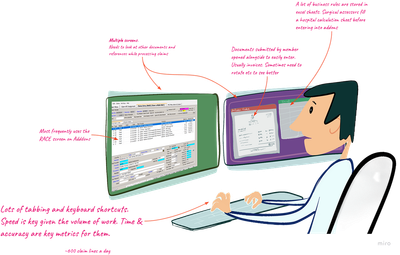
Assessors were not filling in forms. They were comparing a document against a policy, a claim history and prior payments, and deciding whether those agreed. The old system made them retrieve each piece separately, so the comparison happened in their heads and across their desks.

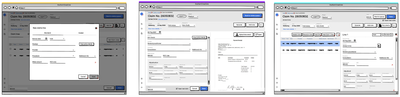
The new interface holds it in one view. Claim lines, episode entry, document panel, history. Every subsequent decision about what to show, collapse or hide was made against that.
Learnability over discoverability
Design usually optimises for discoverability. That is correct for consumer products.
An assessor uses this platform eight hours a day for years. Optimising for their first hour costs them every hour afterwards.
So the platform was built to be learned rather than to be obvious. Harder on day one. Faster for the five years after.
Assessors said the prototype was very different from what they knew. They got used to it within the span of a single session.
The second round of testing brought in the complex scenarios. Claim line entry, episode workflows, the payment receipt panel alongside. BAs came as note-takers. SMEs came for the technical questions.
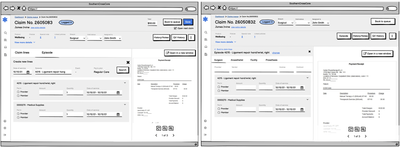
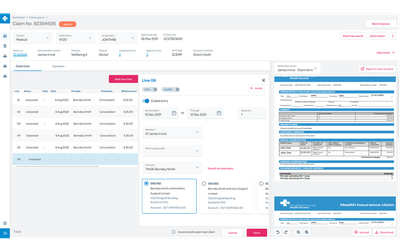
What I wanted was three columns, with documents rendered inline beside the claim and its history. Displaying files that way was not technically feasible, so it was parked. Two columns shipped, and still removed most of the sprawl.
Outcome
Design had no place in this programme when I arrived. Southern Cross funded two more design roles before I left, and I mentored the designers who joined. Design had become a stakeholder the development team consulted rather than a stage they passed through.
I set up experiments to run after launch, on the questions a design phase can't answer.
Where the method stopped
I prototyped in Figma. It shows structure and flow well, and it can't take input. Functionality could only be verified to a limited confidence, and the rest of what testing measured was ease of use as assessors perceived it. None of them entered a claim line until the build existed.
Today I'd build the assessment view as a working prototype, with realistic claims behind it. In the second round, assessors would enter their own data, and the single view would be tested on the task they do eight hours a day. Most of the questions I left for experiments after launch could be answered before development started.